See where your business actually stands on digital growth.
Take the free Digital Readiness Assessment and get a clear snapshot of your digital growth health — with one prioritised next step to act on.
Take the Assessment →Increasing traffic doesn’t guarantee growth. In most cases, the real issue lies within the funnel—where users drop off at multiple stages due to misalignment, friction, and poor conversion design.
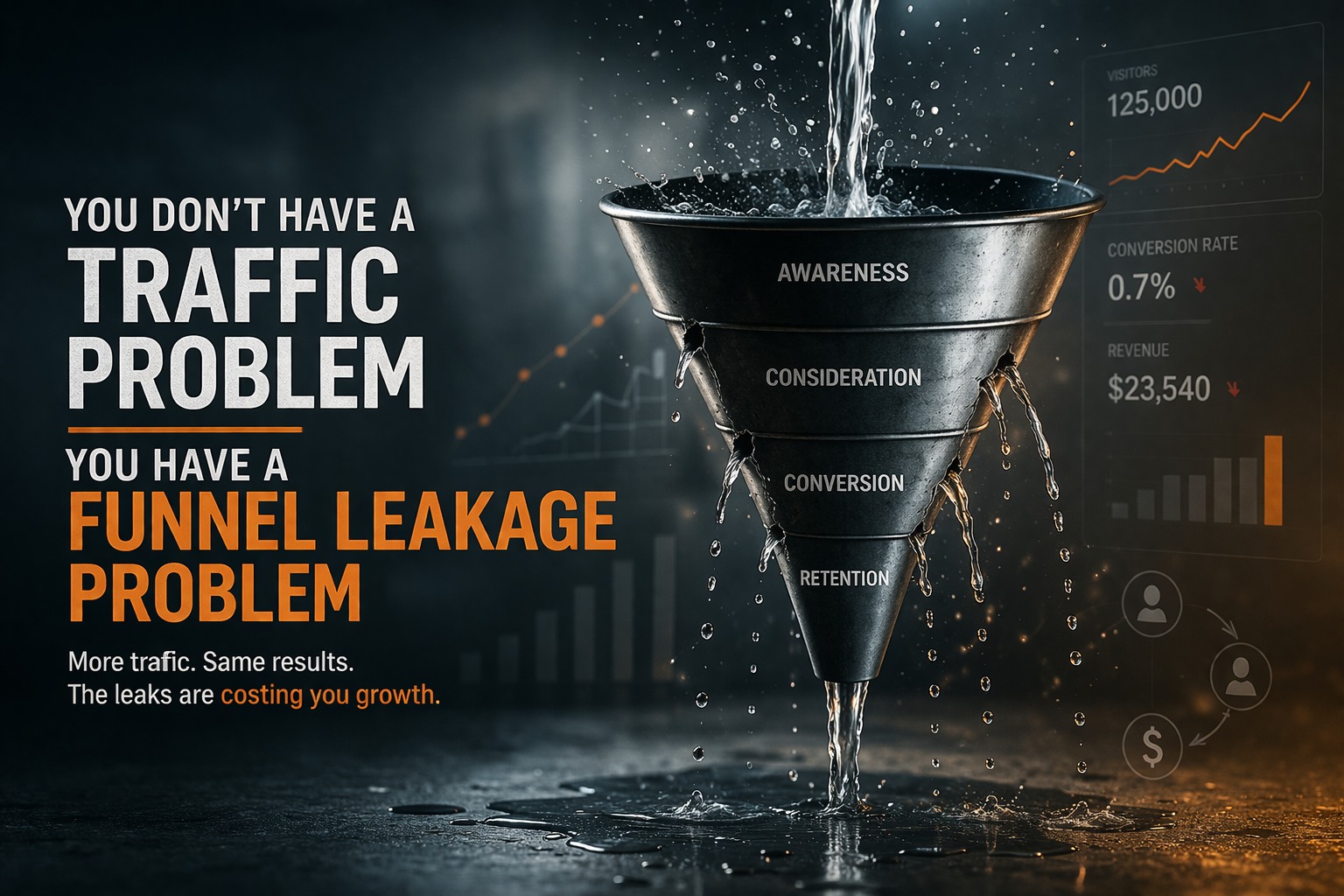
Traffic growth often creates an illusion of progress without improving outcomes Most businesses experience multi-stage funnel leakage, not a single failure point Even small inefficiencies at each stage compound into significant loss of conversions Increasing traffic into a weak funnel amplifies cost without proportional returns Improving conversion rates can deliver 2–3x growth without increasing traffic Sustainable growth comes from optimizing the entire user journey, not just acquisition
For many growing businesses, the default response to slow growth is simple: increase traffic.
More ads.
More campaigns.
More channels.
And on paper, this approach seems logical. If more people are coming in, more customers should come out.
But in most cases, that’s not what happens.
Traffic increases. Costs rise.
Conversions remain inconsistent.
And the gap between effort and outcome continues to widen.
The problem isn’t traffic.
It’s what happens after the traffic arrives.
The Illusion of Growth Through Traffic
Let’s look at a common scenario.
A business increases monthly website traffic from 10,000 to 25,000 visitors through paid campaigns and SEO efforts. On the surface, this looks like strong progress.
But here’s what typically happens inside the funnel:
Despite a 2.5x increase in traffic, actual revenue may only increase marginally—or not at all.
Why?
Because the system was never designed to convert efficiently.
Where the Funnel Actually Breaks
Most businesses don’t have a single-point failure.
They have distributed leakage across the funnel.
1. Entry-Level Leakage (First Impression)
Result:
A large percentage of users drop off within seconds.
Industry data suggests that even a 1-second delay in page load can reduce conversions by 7%. Combine that with unclear messaging, and the initial drop-off compounds quickly.
2. Engagement Leakage (Consideration Stage)
Users who stay don’t necessarily engage.
In many cases, only 10–20% of visitors move beyond the first interaction layer.
This means the majority of your paid traffic never even reaches your core offering.
3. Conversion Leakage (Decision Stage)
Even when users show intent:
Typical landing page conversion rates range between 2%–5%, but in under-optimized funnels, it often drops below 1%.
4. Post-Lead Leakage (Hidden Layer)
This is the most ignored part.
Studies show that responding to leads within 5 minutes can increase conversion chances by up to 9x, yet most businesses take hours—or days.
Why More Traffic Makes the Problem Worse
Increasing traffic into a leaking system doesn’t fix the issue.
It amplifies it.
If your funnel converts at 1%:
But your cost scales linearly, while inefficiencies remain constant.
In many cases, businesses end up spending significantly more to achieve marginal gains, reducing overall ROI.
The Real Opportunity: Fix Before You Scale
Now consider the alternative.
Instead of increasing traffic, you improve funnel efficiency:
That’s a 3x outcome without increasing acquisition cost.
And once the system is optimized, scaling traffic becomes significantly more effective.
Why Funnel Thinking Is Missing
Most businesses operate in silos:
But the funnel is not a set of isolated functions.
It is a connected system.
When these parts are not aligned, users experience friction at every stage—even if each individual component is “working.”
Rethinking Growth
Growth is not just about bringing more people in.
It’s about ensuring that:
Without this alignment, increasing traffic becomes an expensive workaround for deeper issues.
Final Thought
If your current strategy is centered around “getting more traffic,” it’s worth pausing and asking a different question:
How much of your existing traffic are you actually converting?
Because in most cases, the fastest path to growth is not outside the funnel.
It is fixing what’s already inside.