See where your business actually stands on digital growth.
Take the free Digital Readiness Assessment and get a clear snapshot of your digital growth health — with one prioritised next step to act on.
Take the Assessment →What looked like a visibility problem was actually a system failure. By fixing funnel leakage, operational gaps, and dependency on aggregators, Tarang Resort transformed from a loss-making setup into a scalable, profit-generating business—without aggressi
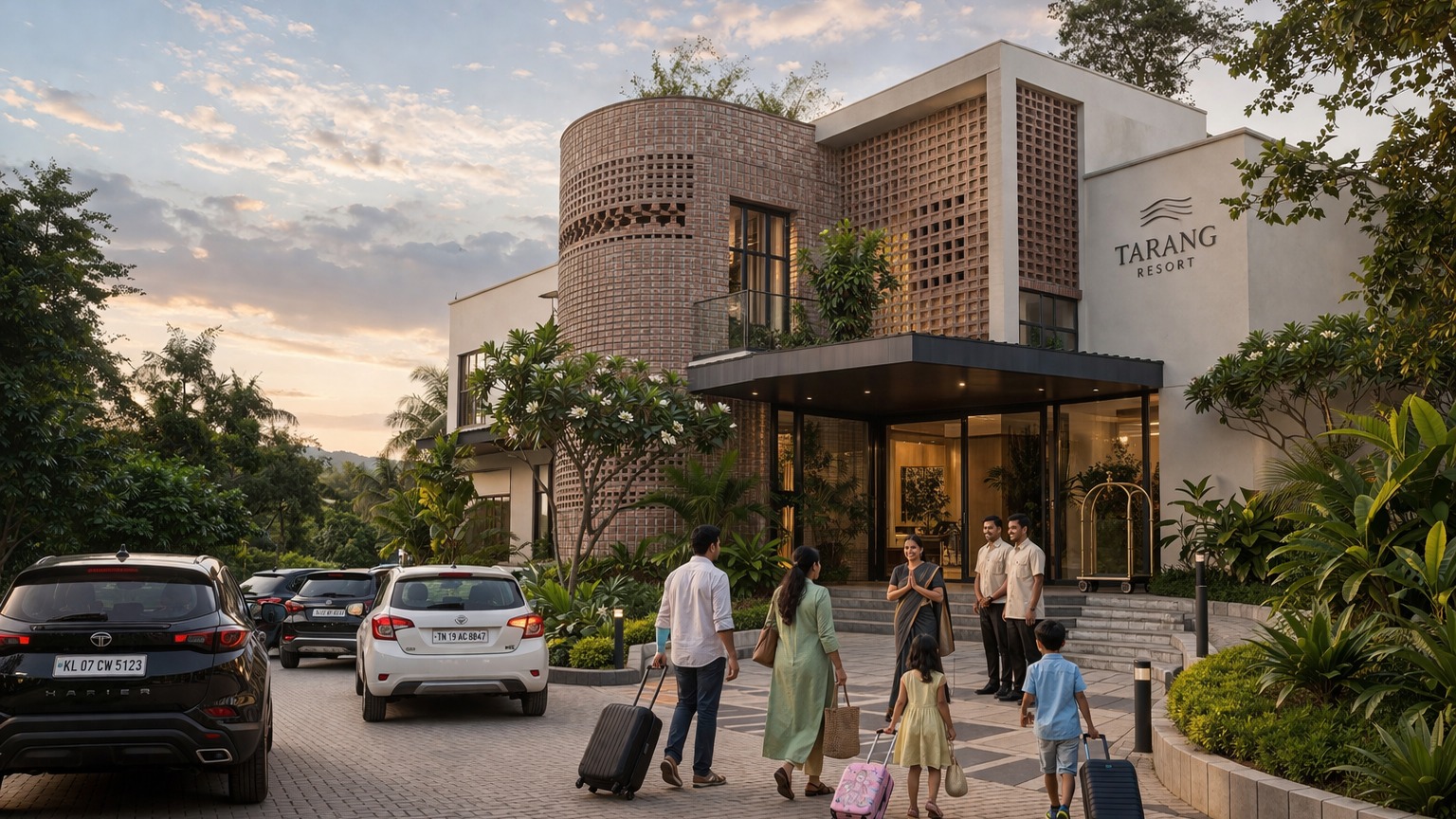
Growth issues were caused by funnel leakage, not lack of demand Conversion rates were below 2–3% despite steady inquiries Over 60–70% dependency on aggregators was eroding margins Structuring inquiry handling and follow-ups significantly improved conversions Shifting toward direct bookings increased control and profitability Marketing spend scaled only after system stability—from near zero to ₹1.25L/month Revenue saw a ~20x increase from baseline within 9 months Operational capacity expanded 3x without adding complexity Real growth came from system alignment, not increased effort
When Tarang Resort first came into discussion, the problem seemed straightforward.
Occupancy was inconsistent. Revenue was unpredictable. The business was running at a loss despite being operational for a while.
The immediate assumption was familiar—there wasn’t enough visibility.
But that assumption didn’t hold for long.
Because demand, in fragments, already existed.
The real issue was what happened to that demand once it entered the system.
At that stage, the resort was being run almost entirely by one person. Every decision, every guest interaction, every booking dependency flowed through a single point. On some days, this worked. On most days, it created bottlenecks.
There was no structured way to handle inquiries. Calls would come in, messages would be missed, follow-ups depended on memory rather than process. Bookings came in through third-party platforms, but there was no real ownership of customer relationships.
Despite effort being high, outcomes were inconsistent.
In a typical month, the resort would see around 800–1,200 inquiry-level interactions across calls, walk-ins, and platform visibility. But actual confirmed bookings remained disproportionately low. Conversion efficiency, when loosely estimated, was below 2–3%.
At the same time, nearly 60–70% of bookings were coming through aggregator platforms, cutting into margins through commissions.
From the outside, it looked like a marketing problem.
From inside, it was clearly something else.
What became evident early on was this:
There was no defined system connecting discovery, decision, booking, and retention.
People were discovering the resort—but not getting enough clarity to decide. Some showed intent—but were not followed up effectively. Guests visited—but their data was not captured in a way that allowed re-engagement.
In most growing businesses, what actually happens is not a lack of demand—but a continuous loss of value at each stage.
This was one of those cases.
The first shift was not to increase activity, but to introduce clarity.
Instead of asking how to get more people in, the focus moved to understanding how the existing flow was behaving.
Where were people dropping off?
Why were inquiries not converting?
What was happening after a guest completed a stay?
These questions didn’t lead to new tools.
They led to structural changes.
Over the next few weeks, the business began to move away from reactive operations to simple, repeatable systems.
Inquiry handling was structured. Every incoming lead—whether from a call, message, or platform—was tracked and followed up within a defined window. This alone improved response consistency significantly.
Booking flow was simplified. Instead of fragmented communication, there was a clearer path from inquiry to confirmation.
Basic customer data started getting captured—not in a complex system, but in a way that made future engagement possible.
None of this was sophisticated.
But it was consistent.
At the same time, dependency on aggregator platforms was gradually reduced—not eliminated, but balanced.
Earlier, nearly 70% of bookings were platform-driven. Within a few months, direct inquiries began increasing, and the share of direct bookings started improving steadily.
This had a direct impact on margins.
Only after these foundational shifts did marketing come into focus.
And even then, it was not treated as a volume game.
Social media was introduced with intent—clear positioning, relevant messaging, and consistency. Instead of irregular posts, communication began aligning with what customers were actually looking for.
Budget allocation followed a phased approach.
From almost negligible spend, the business gradually scaled to approximately ₹1.25 lakh per month on social media and digital efforts.
But unlike before, this spend was now feeding into a system that was capable of converting.
The impact, over a period of 9 months, was not just visible—it was structural.
The business moved from being loss-making to self-sustaining.
Revenue, compared to the baseline phase, saw a significant jump—close to 20x when measured from the lowest point of operations.
Operational capacity expanded nearly 3 times, not by adding complexity, but by removing friction.
Most importantly, the business was no longer dependent on a single individual to function.
There was a system in place.
What makes this case relevant is not the scale of growth.
It is the nature of the shift.
At no point was growth driven by aggressive spending or rapid expansion.
It was driven by fixing what was already broken.
In many businesses, especially in hospitality and service-driven sectors, growth is often pursued externally—more marketing, more channels, more visibility.
But what actually happens is that the internal system remains unchanged.
And that system continues to leak value.
This case reinforces a simple but often overlooked reality:
When the system is unclear, more effort creates more chaos.
When the system is aligned, even modest effort creates disproportionate results.
Before asking how to grow faster, it is worth asking:
Where is the current system losing value?
Because in most cases, that’s where growth is already waiting.