See where your business actually stands on digital growth.
Take the free Digital Readiness Assessment and get a clear snapshot of your digital growth health — with one prioritised next step to act on.
Take the Assessment →Most businesses try to grow by adding more—more traffic, more tools, more effort. This framework helps you step back, identify where value is actually being lost, and focus on fixing the real constraint.
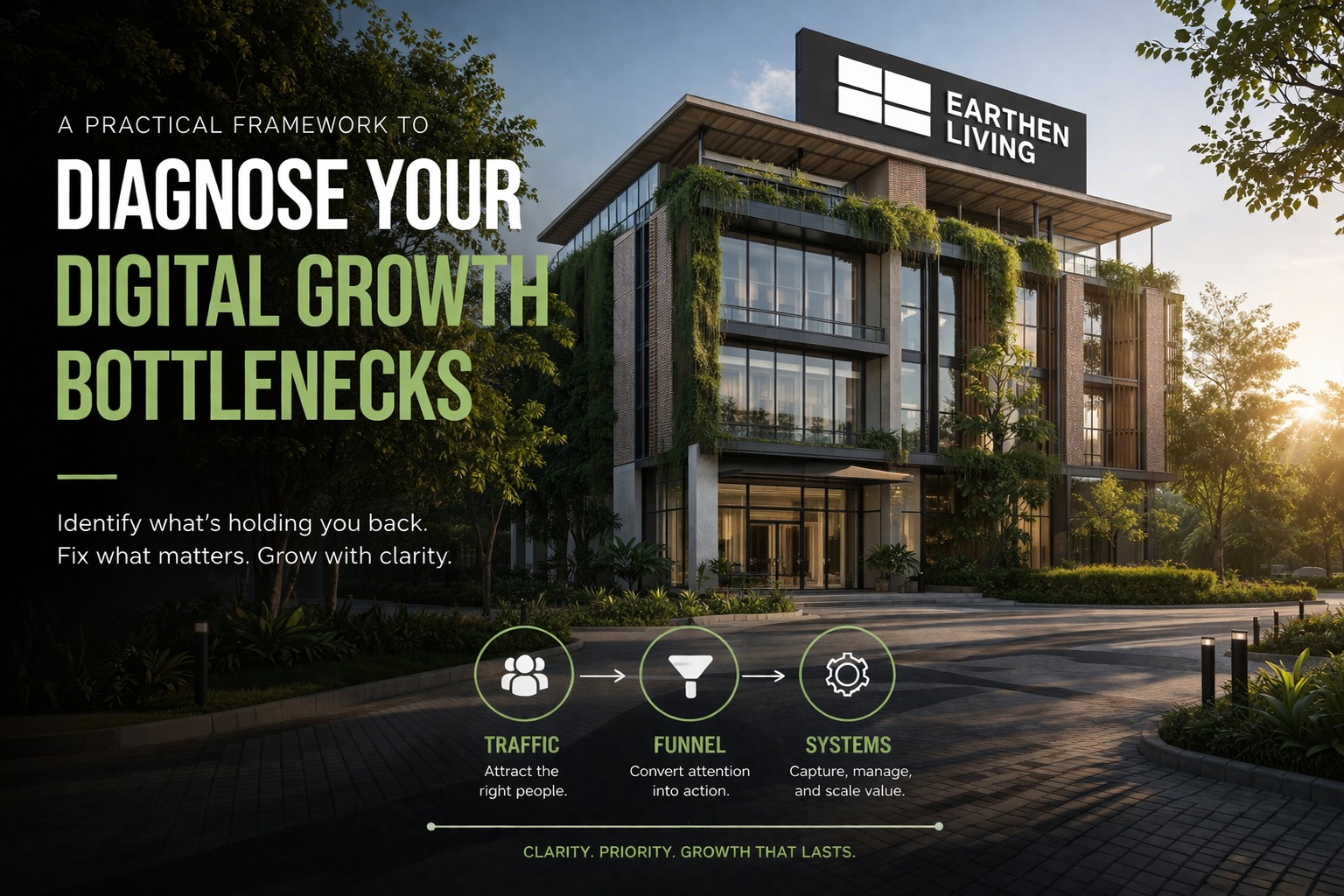
Growth is driven by three layers: Traffic, Funnel, and Systems Most businesses over-invest in traffic while ignoring conversion and systems Funnel inefficiencies often limit growth more than lack of visibility Poor systems lead to lost leads, slow decisions, and inconsistent execution Increasing input into a weak system amplifies inefficiency, not results The fastest path to growth is identifying and fixing the primary constraint Improving conversion (e.g., 1% → 3%) can multiply outcomes without more traffic Sustainable growth requires alignment across all three layers Better growth decisions come from clarity, not more activity
Growth rarely fails because of lack of effort. It fails because effort is applied in the wrong place.
Most businesses try to fix outcomes—more traffic, more leads, more campaigns—without understanding where the actual constraint exists. As a result, they add activity, but not clarity. This framework is designed to do one thing:
help you identify where your growth is actually breaking down.
Every digital growth system operates across three interconnected layers:
How people discover you.
This includes:
At this layer, the question is simple:
Are the right people reaching you consistently?
What happens after people arrive.
This includes:
The key question here:
Are visitors converting into meaningful actions?
What happens after conversion.
This includes:
The critical question:
Can your business capture, manage, and grow value from demand?
Most growth efforts are heavily biased toward Traffic.
When results slow down, the default response is:
But in many cases:
This creates a pattern where businesses keep pushing more input into a system that is not optimized to convert or scale.
Instead of asking “What should we do next?”, shift to:
Where are we losing value right now?
Below is a structured way to identify that.
If yes, the issue may not be volume—it may be targeting or positioning.
If yes, you are likely experiencing funnel leakage.
If yes, your systems are not supporting scale.
Certain patterns consistently indicate deeper issues:
These are not surface-level problems.
They are structural signals.
One of the biggest mistakes businesses make is trying to fix everything at once.
Instead, prioritize based on impact.
Ask:
It is usually:
If your funnel converts at 1%, increasing traffic will only amplify inefficiency.
Improving it to 3% can:
If your backend cannot handle growth:
Growth without systems creates fragility.
Only after:
Should you increase:
Growth is not linear.
It is constrained by the weakest layer in your system.
Real growth happens when all three are aligned.
Most businesses don’t have a growth problem.
They have a visibility problem into where growth is breaking down.
Once that becomes clear, the path forward is usually simpler than expected.
Not easy—but clear.
Start here:
If you can do this well, you don’t need more tactics.
You need better decisions.
If you’ve gone through this and identified gaps—but are unsure how to prioritize or structure the solution—
That’s usually where an external perspective helps.
Not to add more activity,
but to bring clarity to what actually needs to be solved.