See where your business actually stands on digital growth.
Take the free Digital Readiness Assessment and get a clear snapshot of your digital growth health — with one prioritised next step to act on.
Take the Assessment →7 conversion failures that quietly cost growing businesses enquiries every single day
Today, a significant portion of users will never see your website on a large screen. If your pages load slowly, elements overlap, or buttons are difficult to interact with — visitors leave before engaging.
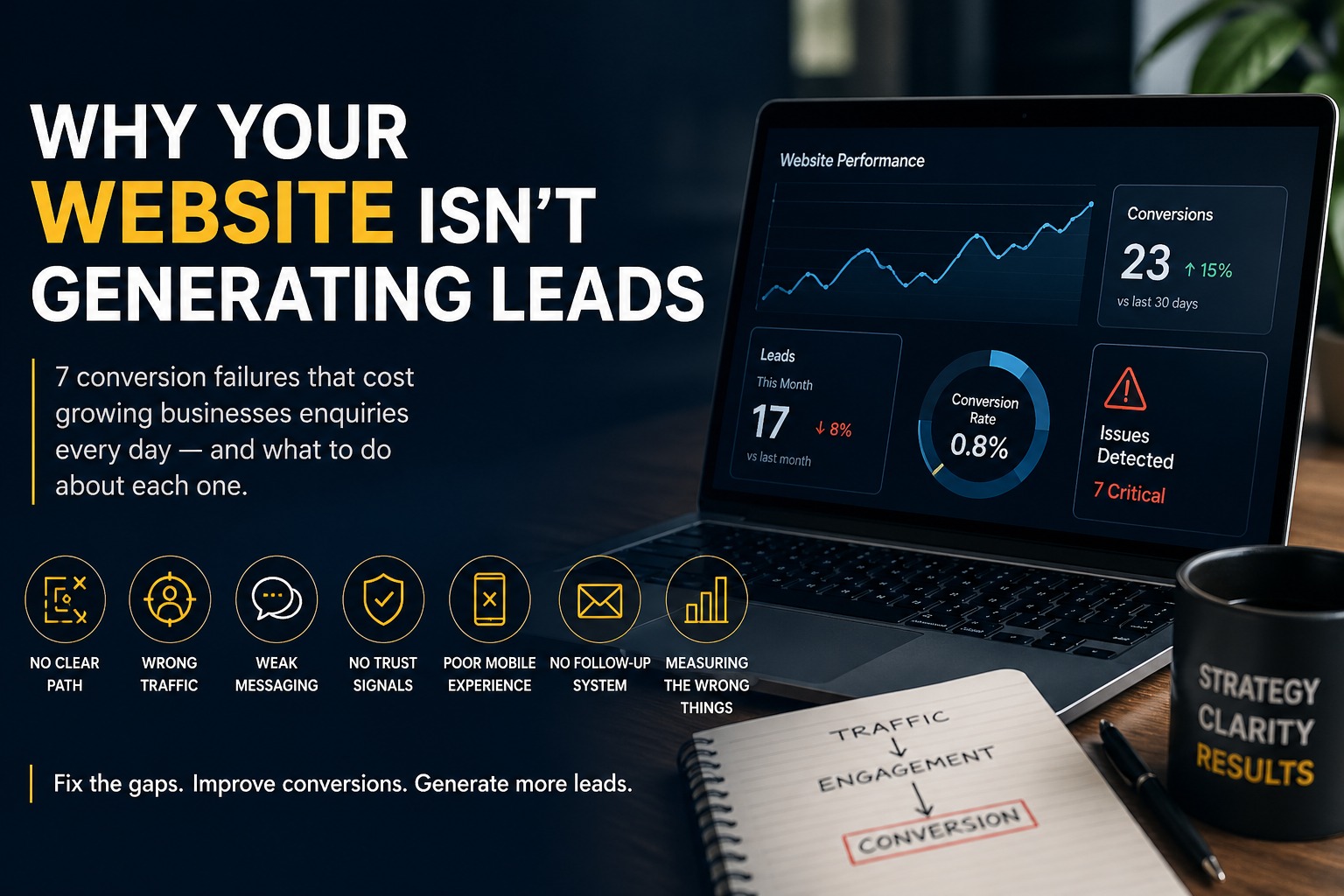
Most businesses assume that low leads are a traffic problem. In reality, it rarely is. The traffic is often already there — what’s missing is conversion. Visitors arrive, browse, and leave without taking action.
Across industries — from e-commerce and fintech to hospitality and professional services — the pattern is consistent. The issue is not visibility, but what happens after the click.
This article breaks down the seven most common conversion failures and, more importantly, what to do about each one.
A visitor lands on your website, reads about your services, and leaves. Not because they are not interested — but because they were never directed.
Most websites inform. Very few guide.
This usually happens because the site is designed for aesthetics rather than behaviour. The structure looks good, but there is no intentional flow telling the visitor what to do next.
The correction is straightforward but critical: define one primary action. Whether it’s booking a call, submitting an enquiry, or accessing a tool — make that action visible immediately and consistently across key pages. Everything else should support it, not compete with it.
On paper, your analytics may look healthy. Visitors are coming in, numbers are growing — but enquiries remain flat.
This is a targeting problem.
SEO strategies and paid campaigns are often optimised for volume instead of intent. As a result, you attract people who are browsing, researching, or simply curious — not those ready to solve a problem.
The fix requires honesty. Look at your top traffic sources and ask: would these visitors realistically hire us?
If the answer is no, improving conversion rates won’t help. The acquisition strategy itself needs to shift toward relevance over reach.
Many websites are well-written — but ineffective.
They talk about services, processes, experience, and methodology. From a business perspective, it all makes sense. From a buyer’s perspective, it doesn’t connect.
Customers are not looking for a description of what you do. They are looking for confirmation that you understand their problem.
This is where positioning shifts. Instead of leading with capability, lead with context.
A statement like “You are investing in digital but not seeing results” will always land stronger than “We offer digital strategy consulting.”
Clarity beats completeness.
Even when everything else is working, lack of proof can stop conversion instantly.
If your website has no testimonials, no case studies, no client references, and no measurable outcomes — visitors have no reason to trust you.
This gap often exists because businesses launch quickly and plan to “add proof later.” In practice, that rarely happens.
At a minimum, your homepage should include real testimonials with names and outcomes. One well-structured case study with a tangible result — even approximate — can outperform pages of polished copy.
Proof reduces risk. And conversion is always tied to perceived risk.
A site that works well on desktop but fails on mobile is effectively broken.
Today, a significant portion of users will never see your website on a large screen. If your pages load slowly, elements overlap, or buttons are difficult to interact with — visitors leave before engaging.
This is not a minor technical issue. It is a direct revenue leak.
Run your site through performance tools, but don’t stop there. Open it on a real device and experience it as a first-time visitor. That single exercise will reveal more than any report.
Not every lead converts immediately — in fact, most don’t.
Yet many businesses treat enquiries as binary: either they convert now, or they are lost.
In B2B environments especially, decisions take time. Without a structured follow-up process, interested prospects gradually disengage.
A simple three-touch follow-up system can change this dynamic significantly. Space interactions over a few days and make each one valuable — share insights, relevant content, or observations.
Follow-up should feel like continuation, not pressure.
It’s easy to feel confident when analytics dashboards look positive.
Sessions increase. Bounce rates improve. Time on page goes up.
But none of these guarantee business outcomes.
Vanity metrics are attractive because they are easy to track and optimise. Revenue-linked metrics require more discipline.
Instead, focus on three indicators that actually matter:
enquiries submitted, calls booked, and proposals sent.
These metrics reflect real intent and real movement through your funnel.
Most businesses don’t have a single failure point — they have several small breakdowns across their acquisition and conversion journey. Weak positioning, inefficient channels, unclear messaging, or friction in user experience.
The real challenge is not awareness. It’s prioritisation.
Understanding what is limiting your lead quality and volume — and addressing it in the right sequence — is what drives measurable growth.
If your website is not generating leads, it is not a mystery problem. It is a structural one.
When strategy, messaging, and execution align, conversion becomes predictable — not accidental.
"Helping businesses grow through clear strategy and disciplined execution."